Manual
DUB-1 (a working name) turns the M-VAVE FM-1 into a generative dub techno machine. It plays itself from the moment it's switched on: chord stabs through a resonant low-pass into a tape echo, short FM pings on loops of unequal length, a sub bass on one of five grooves, a four-on-the-floor kick that ducks the rest, a shaker and an open hat, and a bed of vinyl crackle. An eight-bar arrangement takes the kick out for a break, thins the layers and brings them back with a fill, and now and then a stab is thrown into the echo. You don't play it, you steer it: pick a piece and a scale, take notes out, open the filter, push the feedback, hold the echo.
DUB-1 is a fork of AMB-1, Charles Vestal's generative ambient firmware for the FM-1.
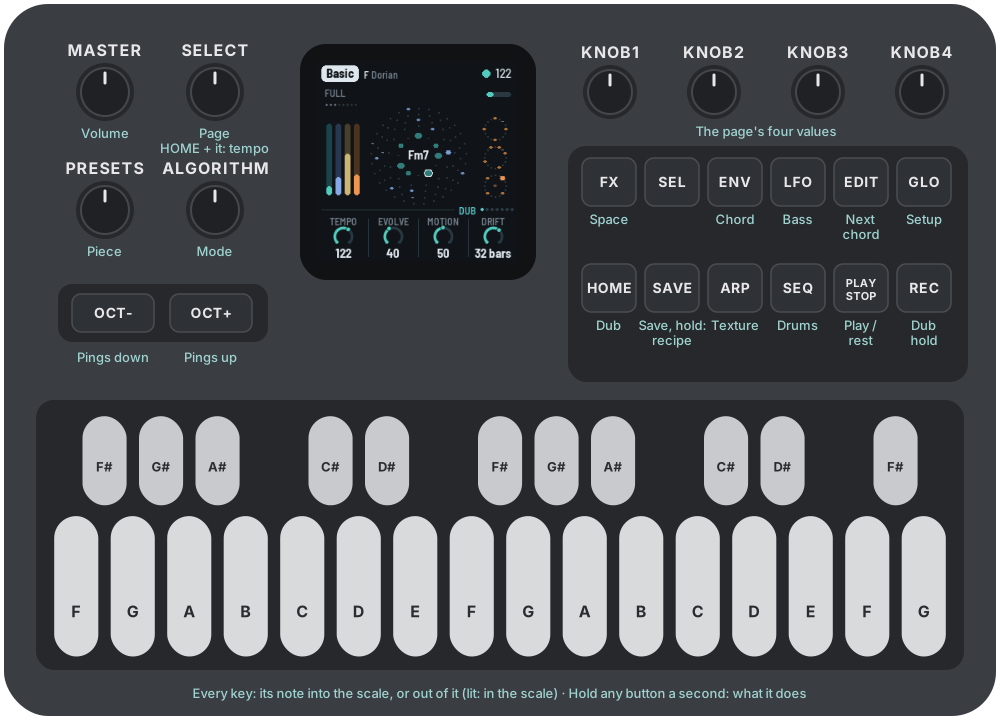
1 Install
Try it first in the browser, with no FM-1: <https://sbegueria.github.io/fm1-dub/emu/>. It's the same code the FM-1 runs, with sound.
Install from the browser: open <https://sbegueria.github.io/fm1-dub/install/> in Chrome or Edge (they have Web MIDI), connect the FM-1 with a USB data cable, switch it on and press Install. Nothing to install on the computer. Don't unplug it while it's writing; when it finishes, the FM-1 restarts into DUB-1.
Or from the command line: download dub-1.0.0.fwsc from the releases, install Python 3 with pip3 install mido python-rtmidi, and run, in a checkout of the source:
python3 tools/fm1_install.py dub-1.0.0.fwscGo back: the installer page's "Back to the stock firmware", or M-VAVE's own updater, M-UPGRADE, puts the stock firmware back.
Installing other firmware is at your own risk. If the FM-1 ever won't start, see Recovering an FM-1 that won't start.
2 Getting started
DUB-1 starts playing as soon as it's on. A few minutes with it:
- Listen. The first piece, Basic, is playing: F Dorian at 122, saw stabs into a dotted-eighth echo, an offbeat sub, the kick, the shaker and the open hat. Turn MASTER for the volume.
- Try another piece. Turn PRESETS. Each of the eight pieces has its own key, tempo, sounds, groove and amount of movement.
- Change the scale. Press a key whose note is lit: it leaves the scale, and nothing plays it any more. Press it again to bring it back. Any key that isn't lit adds its note.
- Move on. Press EDIT: the chord moves to the next one at the start of the next bar.
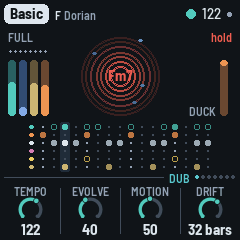
- Hold the echo. Press REC: dub hold. The echo stops listening and repeats what it holds, over and over, while the stabs, pings and drums go on dry above it. Press REC again to let it go.
- Shape a layer. Each layer has a button: ENV the chord, ARP the pings and the crackle (the Texture page), LFO the bass, SEQ the drums, FX the space, HOME the whole (the Dub page), GLO the setup. KNOB 1–4 set the four values at the bottom of the screen. SELECT steps through the pages. Try Cutoff on the Chord page, or Feedback on the Space page.
- Rest. Press PLAY: the music stops and the echo and reverb ring away. PLAY again and it starts from the top of a phrase.
What you change is kept with the piece. DUB-1 saves it by itself while resting, or press SAVE.
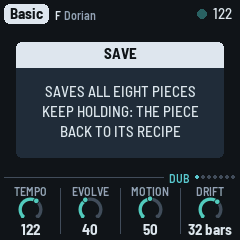
Not sure what a button does? Hold it for a second: a card says. Let go and nothing happens.
3 Controls
The drawing at the top shows them all; here they are in more detail.
| Control | What it does |
|---|---|
| Keys | The scale. Each key adds its note to the scale or takes it out; the keys light up for the notes in it. Every octave of a note is the same key. The root stays ("THE ROOT STAYS"), and the scale keeps at least three notes ("3 NOTES AT LEAST"). |
| PLAY | Play / rest. DUB-1 starts playing by itself when it's switched on. At rest, the echo's feedback eases under 90% so its tails die away, the reverb rings out and the crackle fades. Playing again starts from the first bar of a phrase. Lit while playing. |
| REC | A tap: dub hold: the echo stops listening and repeats what it holds, sample for sample, for ever; the reverb stops listening too and rings on; the chord doesn't move. The stabs, pings and drums go on, dry, above it. Tap again to let go. Lit while held. Held: the effects grid (below). |
| EDIT | A tap: the Chords page (below): eight slots to write the chords. Held (half a second): the next chord, at the start of the next bar (at once while resting; in dub hold, once you let go). |
| SEL | PERFORM: the knobs become a mixer and the keys stop being the scale and play the layers (see below). Press again to go back; lit while on. |
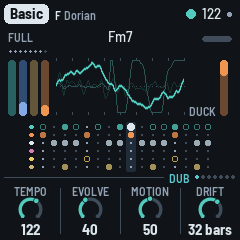
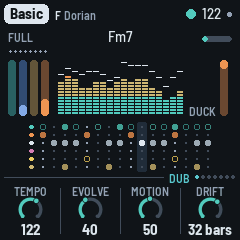
| HOME | The Dub page: tempo and the machine's movement. Again, on the Dub page: the middle of the screen as ripples, a scope or a spectrum. |
| ENV · ARP · LFO · SEQ | The layers' pages: Chord, Texture (the pings and the crackle), Bass, Drums. |
| FX · GLO | The Space and Setup pages. The lit button shows the page. |
| SELECT | The previous or next page. Hold HOME and turn it for the tempo, from any page. |
| ALGORITHM | On a layer's page (Chord, Texture, Bass, Drums): that layer's voice (see The voices). On the other pages: the mode, Ionian, Dorian, Phrygian, Lydian, Mixolydian, Aeolian, pentatonic major and minor; it loads the mode's scale, and editing it with the keys makes it Custom. |
| PRESETS | The piece (see The pieces). |
| KNOB 1–4 | The four values on the screen. A few clicks are always single steps; a quick turn speeds up, so half a turn sweeps the range. |
| OCT− / OCT+ | The pings' octave, two down to two up, from any page. While playing, a ping sounds at once in the new octave. |
| MASTER | Volume. |
| SAVE | Saves all eight pieces. Held for 1.5 s: puts the piece back to its recipe. |
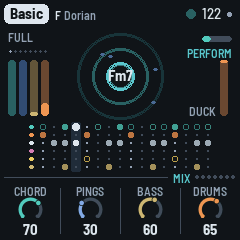
PERFORM (SEL). The knobs become the Mix page: KNOB 1–4 the levels of the chord, the pings, the bass and the drums (the same values as each layer's page). SELECT or a page's button still takes you to the other pages while you perform, and SEL again leaves PERFORM where you are (from the Mix page, back to the page you started from). The white keys from the lowest up:
| Key (white) | 1 | 2 | 3 | 4 | 5 | 6 | 7 | 8 | 9 | 10 |
|---|---|---|---|---|---|---|---|---|---|---|
| Chord | Pings | Bass | Kick | Hats | Throw | Open | Shut | Kick drop | Echo |
- 1–3, the chord, pings and bass: a press turns the layer's level (its Mix knob) to 0, the next to 100; the knob shows it. The key is lit while the level is up.
- 4–5, the kick and the hats (one Drums knob for both): a press mutes, another brings back; lit while playing. The Drums knob follows: 0 once both are out, 100 when one comes back. The mutes stay when you leave PERFORM. The music goes on underneath: a muted layer comes back where it would have been.
- 6–10, moves, held: as long as the key is down, every stab is thrown into the echo (Throw); the filter, and the echo's band-pass with it, pushed open (Open) or shut (Shut); the kick dropped (Kick drop); the echo pushed: everything into it, feeding back more (Echo). Letting go eases back.
- The black keys do nothing in PERFORM; MIDI notes in still change the scale.
The Chords page (EDIT tapped). Eight slots, to write the chords yourself:
| KNOB 1 · Slot | the slot you're editing (1–8), outlined on the screen |
| Keys | its root, any note (lit on the keys); an empty slot becomes a minor chord on it |
| KNOB 2 · Chord | its kind: Empty, Major, Minor, Sus2, Sus4, Dim, Aug |
| KNOB 3 · Type | Triad, 6, 7, Maj7, 9, 11, Add9 |
| KNOB 4 · Play | Random (the chords chosen as described in The arrangement; the slots wait) or Prog (the slots in turn) |
With Play on Prog the slots play from the first, starting on the next bar, a chord every Drift bars (with Drift on Hold, only when you hold EDIT), round again after the last filled slot. An empty slot between two chords holds the one before it for one more turn (it shows "(HOLDS)"). Writing a chord in a slot switches Play to Prog; editing the slot that's playing is heard at once. The screen shows the slot playing lit, and "2/4" under the chord's name on the other pages. EDIT again, or any page's button, leaves the page; EDIT held (half a second), anywhere, moves to the next chord. The slots are kept with the piece.
The effects grid (REC held). After a moment the whole screen shows sixteen effects, four rows of four (the knobs do nothing while it's up); the white keys from the lowest play them, each as long as its key is held (even after you let go of REC). The first key of each row is lit, to find the rows by touch.
| Row | Key 1 | 2 | 3 | 4 |
|---|---|---|---|---|
| Echo (white 1–4) | Throw: every stab thrown into the echo | Time x2: the echo's time doubled (halved if the tape is too short), gliding there and back | Tape stop: the echo's tape slowing to a quarter, its pitch diving | Swell: everything into the echo, feeding back more |
| Filter (5–8) | Low: a low-pass on everything, sweeping down to 350 Hz | High: a high-pass, up to 1.3 kHz (thin, a radio) | Wah: a resonant band sweeping, 1.3 times a second | Phone: a narrow band, 450 Hz to 3 kHz, overdriven |
| Space (9–12) | Verb: everything into the plate | Crash: a burst of noise into the plate, a splash | Freeze: the cloud stops listening, its grains thick and brought forward | Wash: the dry down, everything into the echo and the plate |
| Rhythm (13–16) | Stutter: a sixteenth of the mix caught and looped | Gate: the chord ringing on, chopped in sixteenths | Siren: the dub siren, into the echo | Riser: noise rising through a band-pass, louder as it climbs |
A tap on REC alone is still dub hold; held long enough for the grid (or with a key played), its release does nothing. Each effect eases in and out. All sixteen at once is the heaviest thing DUB-1 can do: in a heavy piece it can approach the FM-1's limit (watch the Setup page's CPU).
Help: hold any button but PLAY and REC for a second and a card says what it does. A key, a knob or another button puts the card away; letting go after it does nothing else.
4 The screen
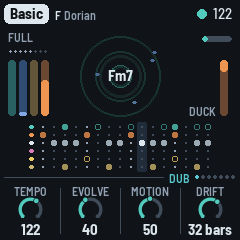
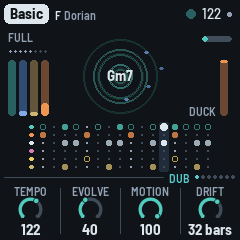
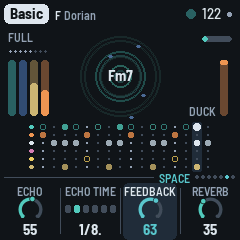
- Top line: the piece in a tag, its root and mode. On the right, a beat light (a play triangle while resting), the tempo (EXT when it follows MIDI clock), a dot when there are unsaved changes, and the battery: three bars (the outline red when it's nearly empty), or the bars filling in turn while USB powers and charges it. Messages ("ADDED F#", "NEXT CHORD ON THE BAR", "DUB HOLD ON", "KICK OFF") show here for a moment.
- Top left: the section playing (FULL in grey; BREAK, GROOVE and THIN lit up) and eight dots, the phrase's bars, lit up to the bar playing.
- Top right: a thin bar fills up on the way to the next chord (none when Drift is Hold); in dub hold it says "hold" in red instead. PERFORM, when SEL's mode is on.
- The ripples: each stab drops a ring in the middle that spreads and fades, and the echo's repeats follow it, a ring each echo time, each as faint as the echo keeps it: a long Feedback makes long trains of rings, a short one a single ring. A stab thrown into the echo makes a double, brighter ring. In dub hold the rings turn red and keep coming, as the echo repeats what it holds. The chord's name is in the middle (red in dub hold). Around it the four ping loops each circle as a blue dot, one step at a time, and light up as they play. The loops have different lengths, so the dots drift apart and meet again.
- HOME again (on the Dub page) changes what the middle shows: the ripples, a scope or a spectrum, and then the ripples again. The choice is saved with the pieces (SAVE). With the scope or the spectrum showing, the chord's name moves to the top. - The scope draws the output (left and right mixed) as a thick line. Each trace starts on a rising zero crossing so the picture stands still, and the two traces before it fade behind. Its height follows the level, so a quiet passage still fills it. - The spectrum splits the output into 18 bands, from the sub bass (43 Hz, left) to the hats (11 kHz, right). Each band is a column of segments: teal, then brass, amber and red at the top. The columns jump up with the sound and fall back slowly. A white cap stays at each column's peak for a moment before it drops.
- Left: the four layers' levels as they sound: chord (teal), pings (blue), bass (brass), drums (amber).
- Right: DUCK, how far the kick is ducking the rest, falling from the top with each kick.
- The lanes: the bar as it plays, sixteen steps, a lane a layer, each marked in its colour on the left: the stabs (teal), the kick (amber), the hats (white), the rim (pink), the clap (yellow), the bass (brass). A hit that only sometimes comes (the clap in Auto, a lane's Chance under 50%) is a ring, filled when it plays. The step playing is lit. A layer that's out (in a Break, muted in PERFORM, or at level 0) has an empty lane at once. In the stabs' lane, rings show where the echo's repeats land, fainter for each, as the echo's time and Feedback have them; each flashes white as the playhead reaches it.
- Bottom: the page's name and seven dots, one a page, then its four values, one for each knob: a dial (or, for a switch, its positions) and the value. The one you're turning lights up.
5 The layers
DUB-1 plays four layers from one scale and one chord, on a grid of sixteenths.
- Chord: the stab. Four voices struck together, each two saws a few cents apart, or an FM electric piano (Keys), through a resonant low-pass that opens with each stab and closes again, then a soft clip. The stabs fall on a Euclidean pattern over the bar, off the beat. One voicing (an open minor 7th, root, fifth, seventh and tenth; or a ninth without its fifth) is shifted whole to each new root, the way a chord memory does, its root kept between F#2 and F3. Most of the stab goes to the echo. Every so often (Drift) the chord moves to another degree of the scale: in a seven-note scale, most often the fourth, then the seventh, the fifth and the sixth; away from home, back home about two times in three. It never moves to a half-diminished chord.
- Pings: short FM blips played by four loops 13, 17, 23 and 29 eighths long. Each loop holds a few notes of the chord (now and then a passing note, or a note an octave up), each in its own register, place in the stereo field and shade of tone, so the loops slide against each other. They go mostly into the echo.
- Bass: a sub on the chord's root, sometimes its fifth, in the sub's band (E1 to Eb2 at home), on one of five grooves: Drone (one long note a bar), Offbeat (the four off-beat eighths), Dotted, Roller and Sync. It slides briefly from note to note. It stays dry, out of the echo.
- Drums: a four-on-the-floor kick (a sine falling fast onto the key's root, F1 to B1, 44 to 62 Hz; below F its fifth; with a click), a shaker on the sixteenths, an open hat off the beat, and a rim (two short tones and a click, mostly sent into the echo, so it echoes away: the dub snare), on two and four once Hits is 70 or more; and a clap (three quick bursts of noise and a tail, into the plate), rarely: on two or four now and then, about one chance in twenty (a little more with Evolve), in Full and Groove phrases. The kick ducks everything else (Duck), and stays out of the echo; the hats send a little to it.
Then the space: a short Echoplex that smears what goes in, the tape echo (up to 5.6 seconds, synced to the tempo, with two heads, the second at three quarters of the loop), a granular cloud and Dattorro's plate reverb. The cloud records what goes to the reverb (the last 0.74 seconds, at a quarter of the sample rate) and plays it back in grains: up to six at a time, each 80 to 250 ms from anywhere in what it holds, at a random place in the stereo field, now and then an octave down (rarely up). The grains go into the plate, so they bloom into its tail, and the plate's tail goes back into the cloud: with Cloud up the reverb turns into a moving wash, longer with a bigger plate. The grains come thicker as the filter opens, and in a Break there is more of the cloud. Dub hold freezes the cloud as it does the echo. In the echo's feedback, a band-pass makes each repeat thinner and darker, and moves with the arrangement; a soft clip lets the feedback pass 100%, so the echo swells on itself without running away. With Motion up, the heads wander across the stereo field, the feedback leans now on one head, now on the other, and every so often the second head slides to another part of the loop (two thirds, a half, three eighths, a quarter), bending the repeats in pitch on the way.
Under it all, crackle: vinyl hiss and clicks, now and then a pop. It plays only while the music plays, fading in and out over about a second.
Dub throws: now and then a stab is thrown hard into the echo, which pushes the feedback up for a moment: the repeats come back louder. Evolve sets how often (more in a Break), and the last stab of a fill is always thrown.
Evolve also keeps the patterns moving: every four bars the stab pattern may turn a step or gain or lose a stab, a stab now and then drops out of a bar, the shaker's steps trade places or gain or lose one, a ping changes note or moves at the end of a pass, a ping loop sits a pass out, the bass jumps an octave up for a note, and when the chord moves it may change voicing. Even at 0, a stab now and then drops out or is thrown.
6 The arrangement
DUB-1 plays in phrases of eight bars. Each phrase is one of four sections:
| Section | What plays |
|---|---|
| Full | Everything. The filter sweeps somewhere between a little dark and open. |
| Break | The kick, the bass and the shaker out (the open hat stays only while Motion is under 50). The filter goes dark, then from the third bar opens up over two bars or so. Throws are more likely. |
| Groove | Every other stab of the pattern; the filter in the middle. |
| Thin | No bass, no shaker. The filter a little darker. |
In the last bar of each phrase, the next one is chosen. Motion sets how often it leaves Full: at 0, never; at 50, about one phrase in three; at 100, more than half the time. When it leaves, a Break is the likeliest, then a Groove, then Thin. From any other section it goes back to Full three times in four (or else from a Break to Thin, from the others to a Break).
Fills: the last bar before the kick comes back from a Break is always a fill, and other phrases end with one now and then (more often with Motion up; never at Motion 0), unless a Break follows. In a fill the kick (if it's playing) drops out for the second half of the bar, the open hat plays (if Hits gives it any steps), and the last stab is thrown into the echo.
The sweep: the arrangement moves a slow filter sweep, from dark to open, and Motion sets how far it goes (at 0 it stays put). It opens the stabs' filter and its resonance, moves the echo's band-pass, thins the pings in the dark and takes a little off the reverb when it's open.
7 The pieces
PRESETS chooses one of eight pieces. Each is a recipe for the whole machine: the layers, the sounds, tempo, key and mode, the groove, the space, how busy it is and how far it moves. Each remembers how you left it. Hold SAVE for 1.5 s to put the piece you're on back to its recipe. Tune, MIDI out and Lights are the same for all.
| Piece | What it is |
|---|---|
| Basic | F Dorian, 122: the reference. Saw stabs into a dotted-eighth echo, an offbeat sub, a new chord every 32 bars. |
| Chamber | A Aeolian, 118: one chord that never moves (Drift on Hold), longer and darker stabs, deep feedback and more echo, a drone bass, straight time, fewer hits. |
| Steppers | D Dorian, 126: shorter, brighter, busier stabs, a dotted bass, a dotted-quarter echo, a new chord every 16 bars. |
| Fog | G Aeolian, 112: FM keys, long dark stabs lost in a quarter-note echo and a big plate, a drone bass an octave down, soft drums, more crackle; the chord moves every 64 bars. |
| Concrete | C pentatonic minor, 130: the fastest. Chords stacked in fourths, short bright stabs, a rolling bass, the drums forward with many shaker hits and bright hats, more swing. |
| Night Drive | Bb Dorian, 124: FM keys, more pings, a half-note echo, a syncopated bass, the most swing; a new chord every 16 bars. |
| Pressure | E Phrygian, 128: the kick and the bass forward and the heaviest ducking, one chord held (Drift on Hold), little reverb or crackle, the least movement. |
| Haze | Eb Ionian, 116: FM keys with the longest stabs, the most echo and feedback, pings an octave up and the most of them, the most crackle, and the most Motion: it leaves Full most often. |
8 The pages
One page a part, each on its own button, with four values on KNOB 1–4. SELECT steps through them in this order.
The voices
On a layer's page, ALGORITHM steps through that layer's voices (after the last, the first again). The voice's name shows at the left of the knob strip, and a message says it ("VOICE Organ"). Each piece keeps its own.
| Page | Voices |
|---|---|
| Chord (ENV) | Saws (two detuned saws a voice), Keys (an FM electric piano), Organ (four drawbars, longer), Pad (the saws swelling in, long), Bell (FM at 3.5, the clang dying first), Tonewheel (a second organ: drawbars, a quick percussion and a key click at each strike, a rotary speaker turning left and right), Noise (noise through the resonant filter, a little saw under it) |
| Texture (ARP), the pings | Blip, Marimba (a wooden bar), Glass (long and bright), Wood (a knock), Drop (the pitch falling from an octave up) |
| Bass (LFO) | Sub (a sine and a little of its octave), Punch (FM, four operators stacked: a thump in the first 90 ms), Rubber (FM, two pairs, one an octave under, op 4 feeding back), Pluck (FM at 3, gone in 50 ms), Growl (FM at 1: a bite at each note) |
| Drums (SEQ), the kit | Tight, Deep (long, 808-ish), Punch (short and hard), Soft (a muffled thump, no click), Dusty (darker, noisier hats) |
The voices are matched in level, so changing one keeps the mix.
The FM pages
Keys and Bell (chord), every ping voice, and Punch, Rubber, Pluck and Growl (bass) are FM voices: sine operators modulating each other, as in the FM-1's own firmware and the 4-operator FM synths. On those, the layer's button pressed a third time (after the sound page) opens its FM page. On a voice that isn't FM (Saws, Organ, Pad, Tonewheel, Noise; Sub) the page says so and names the FM ones: turn ALGORITHM there to pick one.
- Algo: which operators modulate which. Voice (the voice's own), or one of the classic eight 4-operator algorithms (1: a stack of four; 5: two pairs; 8: four sines side by side), or 2-op (one modulator into one carrier). The screen draws it: the carriers (heard) on the line, each modulator above the one it modulates, operator 4's feedback as a loop.
- Ratio: operators 3 and 4's pitch against the note, from half to twice the voice's.
- Feedback: operator 4 modulating itself: from pure to gritty, towards noise.
- Mod dec: how long the modulators take to fade: the brightness of each note's start, shorter or longer.
As on the sound pages, each is relative to the voice (0, or Voice), stays when the voice changes, and is kept by the piece.
The sound pages
Press a layer's button again (ENV on the Chord page, ARP on Texture, LFO on Bass, SEQ on Drums) for its sound page: four more knobs that shape its voice. The button blinks while you're there; press it again to go back, or go anywhere else as usual. ALGORITHM still changes the voice.
Each knob is relative to the voice as it is: 0, the middle, is the preset; turning moves away from it, to −50 or +50. Your turns stay when you change the voice, so a chord made slower and brighter stays slower and brighter on the next voice. Holding SAVE (the piece back to its recipe) puts them back to 0. Each piece keeps its own.
In place of the ripples, the screen draws the layer's envelope as it will sound, and how long it lasts; the second, dotted curve is the chord's filter envelope, the pings' bend or the kick's pitch.
| Sound page | KNOB 1 | KNOB 2 | KNOB 3 | KNOB 4 |
|---|---|---|---|---|
| Chord | Attack: up, a slower strike, to a swell; down, a snap | Colour: as each voice has it: the saws' detune, the FM voices' brightness, the organs' upper drawbars, the noise against its saw | Reso: the filter's resonance | Env: how far each stab opens the filter |
| Pings | Tone: round to metallic (moves the piece's Ping tone) | Ratio: the FM modulator, from harmonic to clangy | Length | Bend: the pitch falling at the strike (up to from four times its note) |
| Bass | Bite: drive, and Growl's bite | Shape: up, towards a square; down, towards a pure sine | Length: how long each note holds, against its groove's | Slide: the glide between notes, ~1 ms to ~250 ms |
| Drums | Kick tune: semitones from the key's note, −12 to +12 | Kick len | Punch: the kick's start pitch and its click | Hats: dark to bright (moves the piece's Hats colour) |
Decay (Chord page) is the voice's length times its own: an Organ or a Pad rings longer than Saws at the same Decay.
HOME: Dub
- HOME again, on this page: the middle of the screen as ripples, scope or spectrum (see The screen).
- Tempo: 90 to 140 (also HOME + SELECT, from any page).
- Evolve: how restless it is: the stab pattern turning and gaining or losing stabs, stabs dropping out, the shaker's pattern, the pings' notes, loops sitting out, octave jumps in the bass, and dub throws (see The layers). At 0, with Motion at 0 too, it's a strict loop: every stab every bar, no throws, no fills (good for playing along with other gear).
- Motion: how often the arrangement leaves Full, how far the filter sweeps, how likely a fill is, and how much the echo's heads, the filter and the band-pass wander.
- Drift: how many bars a chord lasts before it moves on: 2, 4, 8, 16, 32 or 64 bars, or Hold (it moves only when you press EDIT). The chord moves at the start of a bar.
ENV: Chord
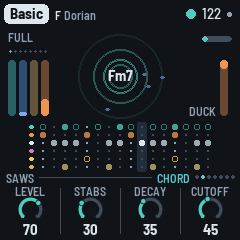
- Level.
- Stabs: how many stabs a bar, from one (0 to 9) to six (90 and up), on a Euclidean pattern off the beat. Evolve may add or take one now and then.
- Decay: how long a stab rings, from 60 ms to 1.5 s. The filter's own envelope is quicker.
- Cutoff: where the low-pass sits, from 110 Hz to 5.4 kHz. Each stab opens it further for a moment, and the arrangement's sweep moves it (with Motion).
The stab's sound, saws or FM keys, comes with the piece.
ARP: Texture
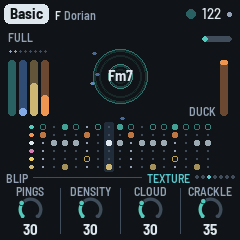
- Pings: the pings' level.
- Density: how many notes each loop holds, none at 0 to five at the top, a little fewer while the sweep is dark. A change shows up as each loop comes round.
- Cloud: how much of the reverb goes through the granular cloud: at 0 the plate alone, at the top a thick wash of grains.
- Crackle: the vinyl's level, and how many clicks a second.
OCT− and OCT+ set the pings' octave, two down to two up.
LFO: Bass
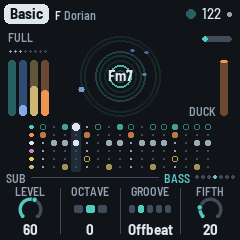
- Level.
- Octave: −1, 0 or +1. At 0 the bass sits between E1 and Eb2 (41 to 78 Hz); at +1 an octave higher; at −1 an octave lower, E0 to Eb1 (21 to 39 Hz): felt more than heard, and lost on small speakers.
- Groove: Drone (one note a bar, held almost to the next), Offbeat (the four off-beat eighths), Dotted (two notes a dotted eighth apart, twice a bar), Roller (six notes a bar, rolling) or Sync (three notes, syncopated).
- Fifth: how often a note is the chord's fifth instead of its root. A note on the bar's first sixteenth is the root, except with Drone: there Fifth sets how often a whole bar is the fifth.
SEQ: Drums
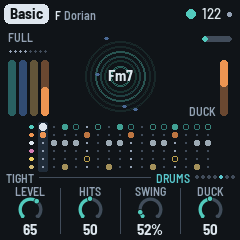
- Level: the kick, the shaker, the open hat and the rim together. The kick is on the four beats (unless the Pattern page says otherwise), except in a Break and the second half of a fill.
- Hits: how busy the hats are. The shaker plays from none to all twelve sixteenths that aren't the open hat's, the ones before the beats first. The open hat comes in at 15, on the off-beat of beats 1 and 3, and plays all four off-beats from 40. At 0, kick only.
- Swing: the shaker's off sixteenths later, from straight (50%) to a heavy lilt (70%).
- Duck: how far the kick pushes the rest down, to −12 dB at 100, letting it back in over a little more than a tenth of a second. The crackle isn't ducked.
How dark or bright the hats are comes with the piece.
The Pattern page (SEQ a third time, after the Drum sound page): the drums' four lanes, sixteen steps each, to write yourself.
| KNOB 1 · Lane | Kick, Shaker, Open (hat), Rim, Clap |
| White keys 1–16 | the lane's sixteen steps: a key turns its step on or off (lit when on) |
| A black key held + a white key | that step accented (on, and drawn taller) |
| KNOB 2 · Accent | how much quieter the unaccented steps are, 0 to 100 |
| KNOB 3 · Chance | how likely the lane's steps are to play, 0 to 100%: loose, breathing hats (the clap starts at 5%: rare, as it shines) |
| KNOB 4 · Play | Auto (the patterns generated from Hits, as ever) or Pattern (yours) |
The first step you change takes the pattern over from what Auto was playing, and switches Play to Pattern. The arrangement still takes lanes out over yours (a Break, the second half of a fill, PERFORM's mutes), and Swing still delays the off sixteenths. The patterns are kept with the piece.
FX: Space
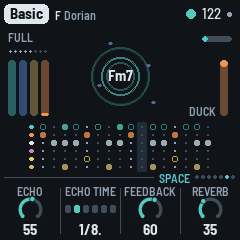
- Echo: how much goes to the echo.
- Echo time: the tape loop's length: an eighth, a dotted eighth, a quarter, a dotted quarter, a half or one bar. The second head repeats at three quarters of it, or with Motion up, wherever it has slid to.
- Feedback: how much of each repeat goes round again, from 45% to past 100% at the top: there, the soft clip holds it, and the echo swells and smears on itself instead of dying away. While resting it's kept under 90%, so the tails always die out.
- Reverb: how much goes to the plate.
How long the plate rings comes with the piece.
GLO: Setup
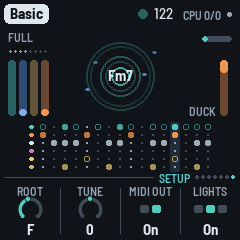
- Root: the key's root note. The scale moves with it, and the chord at once.
- Tune: fine tuning, ±50 cents.
- MIDI out: on or off.
- Lights: On: the keys light the scale, and the unlit buttons glow dimly so they can be read on the black FM-1. Keys: the key lights only. Off.
The top right of this page shows how much of the FM-1's time the sound takes: CPU 35/61 is 35% now (smoothed) and 61% at the heaviest moment of the last two seconds. Under 100% the sound never breaks up; if it ever did, a ! and a count of the dropouts would follow. Above the main screen, BATT and a rough charge in % (with the divider's raw reading), or USB when a computer powers (and charges) the FM-1.
9 MIDI
MIDI comes in over USB and the TRS jack, and goes out over USB.
- In, channel 1: a note adds or removes its note from the scale, like a key.
- In, clock: the grid follows MIDI clock (six clocks a sixteenth), and start, continue and stop start, continue and stop the music. The screen shows EXT for the tempo. When the clock stops coming, DUB-1 goes back to its own tempo.
- Out (on by default): the chord on channel 1, the pings on 2, the bass on 3 and the drums on 10 (kick 36, shaker 42, open hat 46), and, while it plays on its own tempo, clock with start / stop. Turning MIDI out off sends All Notes Off on channels 1, 2, 3 and 10.
Screen reader
DUB-1 can tell a screen reader what its screen shows. Connect the FM-1 by USB, open the FM-1 Screen Reader in Chrome or Edge, and click Connect. It reads out the page you're on and its knobs, a knob's value as you turn it, the piece and its key, the notes you add or take out, help cards, every message, and the chord each time it moves. Press W to hear the whole screen again: the page, the piece, the chord, the section and its bar, and the scale. The FM-1 says nothing until the page connects, so a DAW on the same cable never sees it.
DUB-1's word list (how the reader says what's written on the screen) is published with DUB-1's site, and the FM-1 tells the reader where to find it.
10 Saving
DUB-1 keeps all eight pieces in the FM-1's memory, each as you left it: the knobs, the scale, the mode, the root, the tempo and the pings' octave, plus Tune, MIDI out and Lights.
- By itself: a few seconds after a change, but only while resting and once the stabs have died away. Writing to the memory interrupts the sound for a moment, so it never happens while the music plays. A dot at the top of the screen means there are unsaved changes.
- SAVE: saves now, playing or not.
- Hold SAVE for 1.5 s: the piece goes back to its recipe ("RESET"). That isn't saved until the next save, so switching off before then brings your version back.
Projects saved by AMB-1 aren't read by DUB-1: the first start after installing it begins with the eight recipes.
11 Troubleshooting
Update mode: hold OCT- and OCT+ together for five seconds. A countdown appears; let go before it ends to cancel.
Calibration: if a button or knob does the wrong thing, hold OCT- and OCT+ while you switch the FM-1 on. The screen then asks you to press each button and turn each knob in turn.
After a crash: DUB-1 shows a red CRASH screen and restarts by itself a few seconds later. The next start shows RESTARTED AFTER A CRASH and an address (PC ...) for a moment. If you report the problem, include that address and what you were doing.
Safe mode: if DUB-1 crashes twice in a row while starting, it starts in SAFE MODE instead. There's no sound, but USB works, so the installer can reach it: reinstall with tools/fm1_install.py, or put the stock firmware back with M-UPGRADE. Press PLAY to try starting DUB-1 normally again. If even safe mode fails twice, the FM-1 drops into the chip's own update mode, and only the rescue below can reach it.
Recovering an FM-1 that won't start
An FM-1 in the chip's own update mode shows a blank screen, and neither the installer nor M-VAVE's updater can see it. A script can put M-VAVE's firmware back, on a Mac, with the USB cable you already have.
Open Terminal in a checkout of the DUB-1 source and run:
bash tools/fm1_rescue.sh- If a window asks to install the command line developer tools, click Install. When it has finished, run the line again.
- If it asks for a password, type your Mac password (nothing shows as you type) and press Return.
- When it says it's waiting, plug the FM-1 in and switch it on. The script catches it, checks the chip, saves a backup of the FM-1's memory in the
fm1-rescuefolder in your home folder, and asks before it writes anything. - Type yes and press Return. Don't unplug anything until it says it's restarting the FM-1. The FM-1 then starts into its original firmware, and you can install DUB-1 again from there.
The script downloads its rescue tool from X0X's repository, M-VAVE's FM-1 V15 firmware and JieLi's flash loader, and checks the firmware against a known fingerprint. It writes only the firmware area of the memory, never the bootloader or the FM-1's own settings, and checks everything it writes. Running it again is always safe. If the FM-1 never shows up at all, Felucca's FM-1-transporter (a small RP2040 board wired to the USB lines) can still reach it.
12 Parameters
The defaults are Basic's; each piece has its own.
| Page | Value | Range | Basic |
|---|---|---|---|
| Dub | Tempo | 90–140 | 122 |
| Dub | Evolve | 0–100 | 40 |
| Dub | Motion | 0–100 | 50 |
| Dub | Drift | 2, 4, 8, 16, 32, 64 bars, Hold | 32 bars |
| Chord | Level | 0–100 | 70 |
| Chord | Stabs | 0–100 (1 to 6 a bar) | 30 |
| Chord | Decay | 0–100 (60 ms – 1.5 s) | 35 |
| Chord | Cutoff | 0–100 (110 Hz – 5.4 kHz) | 45 |
| Texture | Pings | 0–100 | 30 |
| Texture | Density | 0–100 (0 to 5 notes a loop) | 30 |
| Texture | Cloud | 0–100 | 30 |
| Texture | Crackle | 0–100 | 35 |
| Bass | Level | 0–100 | 60 |
| Bass | Octave | −1 – +1 | 0 |
| Bass | Groove | Drone, Offbeat, Dotted, Roller, Sync | Offbeat |
| Bass | Fifth | 0–100 | 20 |
| Drums | Level | 0–100 | 65 |
| Drums | Hits | 0–100 | 50 |
| Drums | Swing | 50%–70% | 52% |
| Drums | Duck | 0–100 (to −12 dB) | 50 |
| Space | Echo | 0–100 | 55 |
| Space | Echo time | 1/8, 1/8., 1/4, 1/4., 1/2, 1 bar | 1/8. |
| Space | Feedback | 0–100 (45% – 112%) | 60 |
| Space | Reverb | 0–100 | 35 |
| Setup | Root | C – B | F |
| Setup | Tune | −50 – +50 cents | 0 |
| Setup | MIDI out | Off, On | On |
| Setup | Lights | Off, On, Keys | On |
| ALGORITHM | Mode (Dub, Space, Setup, Mix pages) | 8 modes, or Custom | Dorian |
| ALGORITHM | Chord voice (Chord page) | 7 voices | Saws |
| ALGORITHM | Ping voice (Texture page) | 5 voices | Blip |
| ALGORITHM | Bass voice (Bass page) | 4 voices | Sub |
| ALGORITHM | Kit (Drums page) | 5 kits | Tight |
| Chord sound | Attack, Colour, Reso, Env | −50 – +50 | 0 |
| Ping sound | Tone, Ratio, Length, Bend | −50 – +50 | 0 |
| Bass sound | Bite, Shape, Length, Slide | −50 – +50 | 0 |
| Chord, Ping, Bass FM | Algo | Voice, 1–8, 2-op | Voice |
| Chord, Ping, Bass FM | Ratio, Feedback, Mod dec | −50 – +50 | 0 |
| Drum sound | Kick tune | −12 – +12 semitones | 0 |
| Drum sound | Kick len, Punch, Hats | −50 – +50 | 0 |
| OCT− / OCT+ | Ping octave | −2 – +2 | 0 |
Set by the piece only (no knob): the pings' tone (from a round blip to a metallic clank), the hats' colour, and the plate's size. Each piece also has its own voices and Cloud.
| Piece | Chord | Pings | Bass | Kit | Ping tone | Hats | Size | Cloud |
|---|---|---|---|---|---|---|---|---|
| Basic | Saws | Blip | Sub | Tight | 40 | 50 | 55 | 30 |
| Chamber | Organ | Glass | Sub | Deep | 30 | 40 | 70 | 45 |
| Steppers | Saws | Marimba | Punch | Punch | 50 | 60 | 50 | 20 |
| Fog | Keys | Blip | Sub | Soft | 25 | 30 | 80 | 60 |
| Concrete | Noise | Wood | Pluck | Punch | 60 | 75 | 45 | 15 |
| Night Drive | Keys | Drop | Growl | Tight | 45 | 55 | 60 | 35 |
| Pressure | Tonewheel | Wood | Growl | Deep | 35 | 65 | 40 | 20 |
| Haze | Pad | Glass | Sub | Dusty | 30 | 35 | 85 | 70 |
13 Credits
DUB-1 is free software under the GNU General Public License, version 3. If you share the firmware, you must also share its source code.
- DUB-1 is a fork of AMB-1 by Charles Vestal (GPL-3.0-only), whose loops, echo chain, pieces, UI and platform it keeps.
- The idea comes from AMB-1 and from dub techno in general: chords dissolving in a tape echo over a steady kick.
- The reverb is Jon Dattorro's plate ("Effect Design, Part 1", JAES 1997), by way of FoMni-1.
- The granular cloud follows the design of CLOUD in JIANT (GPL-3.0), another FM-1 firmware.
- The Euclidean rhythms are Godfried Toussaint's reading of Bjorklund's algorithm.
- The random chords are a weighted random walk over the scale's degrees, adapted from AMB-1's (see The layers). They are voiced as dub techno's chord-memory stabs (Basic Channel, Maurizio): one shape, moved whole to each new root.
- The platform (hardware layer, USB, update loader, installer and storage) is from Felucca by Leo Kuroshita, Hügelton Instruments, by way of X0X, FoMni-1 and AMB-1.
- The idea of running FM-1 firmware in the browser comes from Groove OS.
- The fonts are Barlow Semi Condensed and Terminus (SIL Open Font License).
M-VAVE and FM-1 are trademarks of their owners. DUB-1 is not connected with M-VAVE or Hügelton Instruments.